Welcome
Released on January 17, 1966, Simon and Garfunkel’s second album was built on a paradox: its opening track, “The Sound of Silence,” had been overdubbed with electric instruments by producer Tom Wilson without the duo’s knowledge, hit number one on the Billboard Hot 100, and forced a reunion neither had planned.
Hear both on Spotify: the 1964 acoustic original (opens in a new tab) from Wednesday Morning, 3 A.M., and the 1966 electric version (opens in a new tab) Tom Wilson made of it. Same vocal take underneath.
Most of what works in a classroom gets built once, for one course, and then lives on one person's laptop forever. These are the ones worth passing on.
Everything here is free, needs no account and no sign-up, and is yours to adapt. Nothing asks for your students' data, and nothing can run up a bill.
Take them and change them. None of this is locked down. If something is nearly right for your course but not quite, pull it apart - that is what it is for. You do not need to ask, and you do not need to credit anyone.
Guiding Questions
No right answers. They are here to be discussed.
- When will the first single-employee billion-dollar company happen?
- How many AI bots will you manage in the future?
- Do you think AI is going to displace your work?
What the Room Said
How the department answered, so far
What the Room Said
How the department answered, so far
No answers yet - be the first.
Start Here
If you have barely touched AI, start at this one thing and ignore everything below it until you have.
Make America AI-Ready
A free one-week AI course from the U.S. Department of Labor
Make America AI-Ready
A free one-week AI course from the U.S. Department of Labor
- The whole course arrives by text message. No account, no software, no login to forget.
- Ten minutes a day for a week, and it starts by asking how much you already know.
- Built for people who have never used AI at work, which is most of us.
Five Minutes a Day
The fastest way to stop feeling behind is a short daily read. Pick one of these, not both.
Daily Newsletters
Two worth subscribing to - they cover the same ground in different voices
Daily Newsletters
Two worth subscribing to - they cover the same ground in different voices
- The Rundown AI (opens in a new tab) - five-minute read, the plainest of the two
- The Neuron (opens in a new tab) - lighter in tone, same territory
Try It on Real Work
Reading about AI only goes so far. These give you something to paste in and run today.
Prompts and Playbooks
Things you can use in the next twenty minutes
Prompts and Playbooks
Things you can use in the next twenty minutes
- Practical AI prompts for business advising (opens in a new tab) - three prompts from an America's SBDC workshop - document a process, map it, act on it. Copy and paste, no sign-up
- 10 Ways The Rundown Uses AI (opens in a new tab) - a printable guide to how one company actually uses it day to day
- AI Task Delegation Playbook (opens in a new tab) - templates for handing work to AI - free, but you give them an email address
Tools Worth Trying
Start with the first one, which was built for our own courses. The rest are worth a look once you have the hang of things.
Syllabus Chat Bot
This was created by Stacie for us to try out
Syllabus Chat Bot
This was created by Stacie for us to try out
- Students ask in their own words - “can I turn it in late?”, “I missed class, what do I do?” - and get back the answer you wrote.
- You build one for your course in about twenty minutes, with no code.
- It downloads as a SCORM package for Blackboard, Canvas, Moodle or D2L, or as a single web page if you would rather skip the LMS.
- It looks answers up rather than writing them, so it cannot invent a policy you never wrote.
Other Tools to Look At
None of these have been tried properly yet - add what you find to the tracker
Other Tools to Look At
None of these have been tried properly yet - add what you find to the tracker
- BoodleBox (opens in a new tab) - a shared AI workspace built for education, with several models in one place. Free tier
- Beautiful.ai (opens in a new tab) - builds slide decks that lay themselves out. Free trial, then paid
- Grok Bot (opens in a new tab) - AI agents that sign in to your tools and finish tasks. Paid, and Mac only
For Your Discipline
Tools aimed at one subject rather than all of them. Anything the tracker marks as “Using it” turns up here on its own.
Culinary and Hospitality
Culinary and Hospitality
- Demand Delphi (opens in a new tab) - reads a restaurant's own sales history and produces a dish-level ordering guide for the week ahead - a real worked example of forecasting for a food-service class. Currently a pilot, and Massachusetts is one of the two states in it
Marketing
Picked from the Chamber's list of twelve, these are the ones a class can actually use
Marketing
Picked from the Chamber's list of twelve, these are the ones a class can actually use
- Canva Magic Studio (opens in a new tab) - AI inside the drag-and-drop editor students already know: images, copy, background removal, resizing. Free plan includes some AI credits; Pro is $15 a month
- ChatGPT (opens in a new tab) - drafting copy, outlining campaigns, brainstorming. Free plan covers everyday use
- HubSpot AI Marketing Hub (opens in a new tab) - campaign building, content and performance tracking in a CRM students will meet in industry. There is a free version
- Zapier (opens in a new tab) - joins tools together to automate repetitive work - a good way to teach process thinking. Free tier caps at 100 tasks a month
- Surfer SEO (opens in a new tab) - scores content against what already ranks on Google. $99 a month, so one for demonstrating rather than assigning
- All twelve, with pricing (opens in a new tab) - the U.S. Chamber's full round-up, including the pricier monitoring and copywriting tools left out above
What We're Finding
The running list, kept by all of us. Add a row whenever you try something - including the things that turned out not to be worth it.
Department AI Tool Tracker
A shared sheet for what we try, by discipline
Department AI Tool Tracker
A shared sheet for what we try, by discipline
- One row per tool: what it does, which discipline, what it costs, and whether it was any good.
- Dropdowns for discipline, cost and status, so the columns stay sortable.
- There is an OK for student work? column. Many free AI tools keep whatever you paste into them, so check before putting a student's name, grade or submitted work into one - and mark it “Not sure” if you do not know.
- A tool that did not work is worth logging too. It saves the next person the hour.
Benchmarking
Where we are right now, in our own words. Add a word or a short phrase - forty characters, so keep it tight. Run it again next term and we can see what moved.
How We Use AI Ourselves
Type an answer below, or scan to add one from your phone
How We Use AI Ourselves
Type an answer below, or scan to add one from your phone
How We Use AI in Class
Type an answer below, or scan to add one from your phone
How We Use AI in Class
Type an answer below, or scan to add one from your phone
Go Further
For when the basics feel comfortable and you want more than a newsletter.
Longer Courses
Free, structured, and open to anyone
Longer Courses
Free, structured, and open to anyone
- Verizon AI Skills for America (opens in a new tab) - free AI courses at every level, from the beginner end upward, with hands-on practice and certificates you can share. Course material comes from IBM, Google, Microsoft, Anthropic, OpenAI and Coursera. Educators are one of the groups it is explicitly built for. Free account, and you do not have to be a Verizon customer
- LinkedIn Learning (opens in a new tab) - a large course library with a deep AI section alongside everything else. Free through MCC - sign in with your college account, not a personal one, or it will ask you to subscribe
- Verizon Digital Ready (opens in a new tab) - courses, mentoring and grants aimed at small business - good material for anyone teaching entrepreneurship
- Infosys Springboard USA (opens in a new tab) - 13,000+ free courses aimed at higher-ed learners and professionals, from the Infosys Foundation. Free account needed
Worth Reading
Where things actually stand, rather than which button to press
Worth Reading
Where things actually stand, rather than which button to press
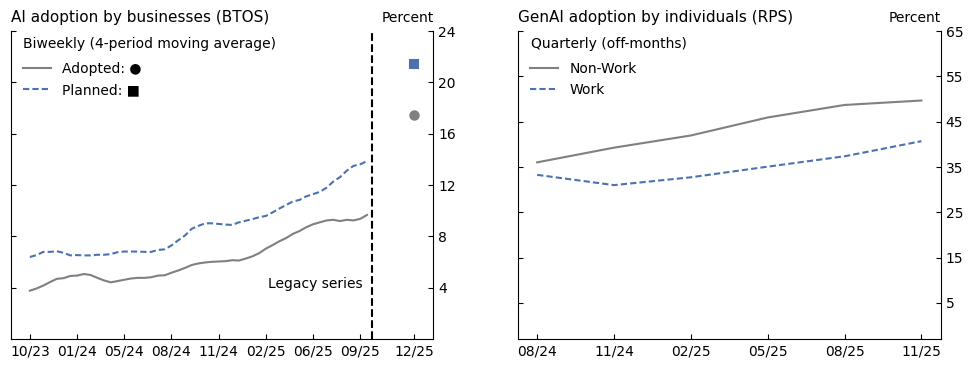
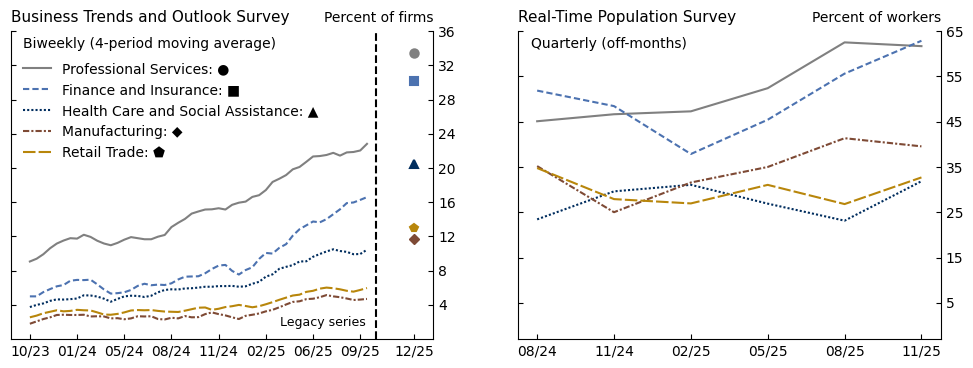
- Monitoring AI Adoption in the U.S. Economy (opens in a new tab) - the Federal Reserve's own count, April 2026. About 18 percent of firms had adopted AI by the end of 2025, and 78 percent of the labour force works somewhere that has. The source of the chart at the top of this page
- Most Small Businesses Are Using AI (opens in a new tab) - Entrepreneur, October 2026. The argument is that using AI is no longer the hard part - using it well is, and that is a training problem. Four suggestions
- Intuit on AI and the future of small business finance (opens in a new tab) - an interview with Intuit's Arundhati Singh on automation in bookkeeping and finance. Worth a look for accounting and bookkeeping
- Deloitte's enterprise AI infrastructure survey (opens in a new tab) - March 2026, 515 leaders at companies above $500 million in revenue - so this is where the big employers our graduates join are heading, not small business. Over 70 percent expect to run AI at scale by 2028
- The Attention Advantage (opens in a new tab) - Harvard Business Impact on why attention, not intelligence, is becoming the scarce thing
- What is a Human in the Loop? (opens in a new tab) - a clear explainer of the idea that gives this page its shape - machine and human working together rather than one replacing the other, with the human checking what the model cannot be trusted to get right. Written by a company that sells exactly that service, so read it as an explainer with an interest, but it is a good explainer
Built to Be Usable by Everyone
Every page and tool here is built to WCAG 2.1 AA. That means it works by keyboard alone, reads properly in a screen reader, holds up at 200% zoom and on a phone, and passes contrast in both light and dark mode. Students who need that should not have to ask for it.
Shared together at Middlesex Community College. If one of these is useful in your course, go for it, that is the whole point.